

Table of Contents
Last update: June 2026. All opinions are my own.
Machine Learning from Scratch · Part 8/12
Part 7 ended with the most important line: don't use a single decision tree, use many. This post is about how.
Two completely different approaches to combining trees, both invented as fixes for the same problem (a lone tree overfits). They produce two of the most powerful tabular-ML algorithms in existence — and a choice you'll face in every real ML project on tables.
- Bagging → Random Forest. Train many trees in parallel on different subsamples, then average. The reliable workhorse. Easy to train. Strong out of the box.
- Boosting → XGBoost. Train trees sequentially, each one correcting the errors of the previous. The Kaggle dominator. Can be more accurate but needs careful tuning.
Why one tree fails
Recap from Part 7. A single decision tree overfits because it can keep splitting until each training point gets its own region. Even with pruning, a single tree:
- Is unstable — small changes in the training data produce a totally different tree.
- Is noisy — the specific splits depend on the specific training rows.
- Has high variance — predictions on similar inputs can swing wildly.
The cure for high variance is the same one statisticians have used for centuries: average over many noisy estimates. The noise tends to cancel; the signal reinforces.
That's the whole insight under bagging. Build many trees, each one a bit different. Average their predictions. The randomness cancels out.
Bagging — bootstrap + aggregate
Bagging = Bootstrap AGGregatING. Two ideas in one name:
- Bootstrap. Generate many subsamples of your training data by sampling with replacement. Each subsample is the same size as the original but with different rows (and some rows duplicated, others missing).
- Aggregate. Train one tree per subsample. To classify a new point, run it through all the trees and aggregate the predictions — majority vote for classification, average for regression.
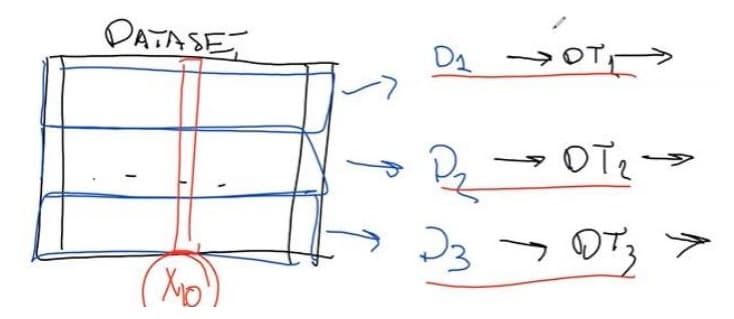
The magic: each tree overfits — but each one overfits a different aspect of the data. When you average them, the overfitting cancels because no two trees overfit in the same way. The underlying signal stays.
That's it. Bagging in one paragraph. It works for any model (you could bag logistic regressions), but it works exceptionally well with trees because trees are high-variance — exactly the kind of model that benefits most from averaging.
The weakness of plain bagging
There's a subtle problem. If one feature is dominant — say, neighbourhood strongly predicts house price — then every tree will use that feature for its top split. The trees end up similar. Their predictions correlate. Averaging correlated predictions doesn't reduce variance much.
The fix is Random Forest.
Random Forest — bagging plus feature subsampling
Random Forest adds one tweak: at every split, only consider a random subset of the features. Typically √p features (for p total).
What this does: even if neighbourhood is the strongest feature, on most splits it's not available to the tree (because that split is constrained to a random subset). So most trees end up using other features for their top splits. The trees become genuinely different from each other.
Different trees → uncorrelated errors → averaging works.
The result is one of the most powerful, most reliable methods in all of ML:
- Captures complex patterns.
- Generalises well.
- Resists overfitting (the more trees, the more averaging — and overfitting decreases monotonically with tree count).
- Handles mixed feature types out of the box.
- Almost no preprocessing required (no scaling, no encoding for trees).
- Robust to outliers.
How many trees? As many as your compute budget allows. More is better — there's no overfitting risk from more trees. Typical: 100–1000.
How deep? Use cross-validation. Random Forests are less sensitive to this than single trees, but a depth limit still helps.
Boosting — the sequential alternative
Boosting takes the opposite philosophy from bagging. Instead of training many trees in parallel and averaging, train trees sequentially, each one correcting the previous one's mistakes.
The procedure:
- Train a small, pruned tree on the data. It's mediocre — by design.
- Compute the model's residuals (errors).
- Train a new tree on the residuals. This tree learns to predict the previous tree's mistakes.
- The final prediction is the sum:
prediction = tree₁ + tree₂. - Compute the new residuals. Train another tree. Add it. Repeat.
Hundreds of trees, each one shrinking the residuals further. The composite model becomes very expressive — it can fit almost any pattern in the training data.
That's also the danger. Because every step drives training error down, boosting will overfit if you let it. The number of trees, the learning rate, the regularization — all critical hyperparameters that need careful tuning.
XGBoost — the canonical implementation
XGBoost (eXtreme Gradient Boosting) is the famous implementation. Plus its cousins LightGBM and CatBoost. They share the boosting idea but add:
- Regularization terms on the tree size and weights.
- Smart parallelisation for fast training.
- Histogram-based splits for huge speedups on big data.
- Handling of missing values without preprocessing.
For tabular ML competitions, XGBoost (or LightGBM) wins more often than anything else. It is genuinely the state of the art for tabular prediction.
Bagging vs Boosting — when to use which
In practice you'll choose between Random Forest and XGBoost on almost every tabular project. Here's the actual trade-off:
| Random Forest | XGBoost | |
|---|---|---|
| Approach | Parallel + averaging | Sequential + error correction |
| Reduces | Variance | Bias (also variance, with care) |
| Overfitting risk | Low | High without tuning |
| Tuning effort | Minimal | High — weeks of experimentation |
| Out-of-box accuracy | Strong | Often higher with careful tuning |
| Robustness in production | Excellent | Fragile if data drifts |
| Kaggle competitions | Used | Dominant |
| Production reality | Often preferred | Risky for changing distributions |
🔑 The practical reality: XGBoost wins on Kaggle because it can squeeze out the last 1-2% of accuracy that decides the leaderboard. In production, many teams prefer Random Forest because you're never quite sure XGBoost isn't overfitting, and you'd have to check every day that the results stay consistent. The marginal accuracy isn't worth the reliability cost.
If accuracy is everything (Kaggle, internal experiments), XGBoost. If reliability and ease of maintenance matter (production systems that have to keep working for years), Random Forest. There's no objectively right choice — it depends on what you're optimising.
The big picture
The recap, in one paragraph:
A single tree carves the dataset into regions and overfits aggressively. Bagging averages many trees trained on bootstrapped subsamples; the overfitting cancels. Random Forest improves bagging by also subsampling features per split, forcing trees to be diverse and de-correlating their errors. Boosting trains trees sequentially, each one correcting the previous one's mistakes; it can be more accurate but is much more prone to overfitting.
The choice between Random Forest and XGBoost is rarely about which is technically "better" — it's about whether you want a robust workhorse you can ship and forget, or a finely-tuned racehorse that needs constant care.
- Random Forest as baseline. Always. It's three lines of code, no tuning. It tells you what's achievable on this problem.
- XGBoost if accuracy gap matters. Tune the depth, learning rate, regularization, and number of trees via cross-validation.
- Ship Random Forest unless XGBoost is clearly better AND the data is stable. The 1% accuracy gain is rarely worth the operational risk.
Next up — Part 9: Support Vector Machines — The Widest Possible Margin. The other dominant classifier of the pre-deep-learning era. Large margins, support vectors, the C knob, and the kernel trick that turns impossible problems into linear ones.